Zaloguj się aby komentować
Zaloguj się aby komentować
Wojna
Treść dla dorosłych lub kontrowersyjna
Newsy książkowe od Whoresbane'a!
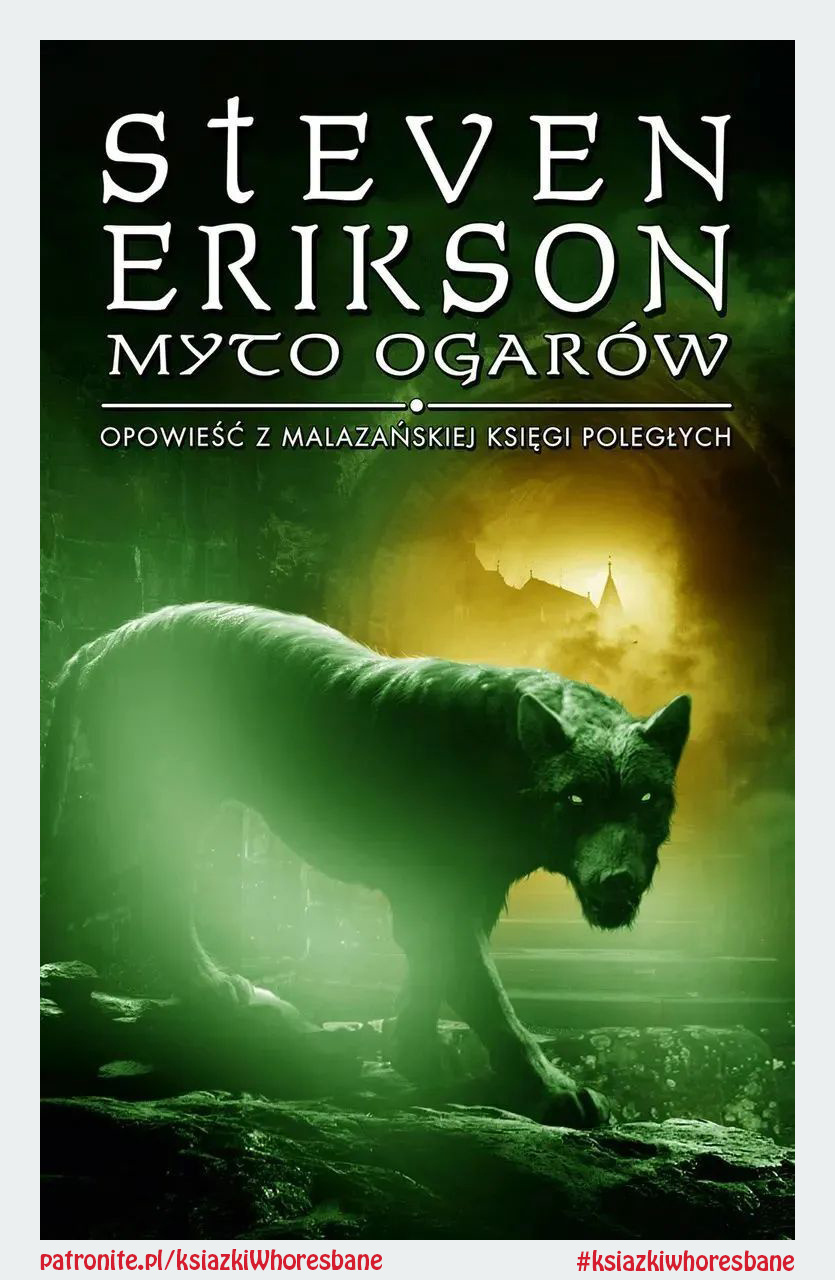
Wydawnictwo MAG dodrukowało ósmy tom Malazańskiej Księgi Poległych. "Myto ogarów" Stevena Eriksona wróciło do sprzedaży 3 lipca 2026 roku. Wydanie w twardej oprawie ma 1104 strony, w cenie detalicznej 89 zł. Poniżej okładka i krótko o treści.
Powiadają, że Kaptur, Pan Śmierci, zgromadził zastęp bogów w miejscu znajdującym się poza zasięgiem śmiertelników. Powiadają, że czeka on na końcu każdego planu i spisku, wszystkich zakrojonych na wielką skalę ambicji. Tym razem jednak sprawy mają się inaczej. Tym razem Kaptur jest na początku…
Darudżystan poci się w letnim upale. Miasto jest pełne złowrogich omenów, niepokojących pogłosek i podstępnych szeptów. Przybyli obcy, morderca wziął się do roboty, możliwe też, że budzi się pradawna tyrania. Na byłych Podpalaczy Mostów z Baru K’rula zwrócili swe śmiercionośne spojrzenia miejscy skrytobójcy. Niski, korpulentny człowieczek w czerwonej kamizelce jest przerażony swą wciąż rosnącą tuszą, wie jednak, że to najmniejsze z jego zmartwień. Gdzieś w dali słychać bowiem ujadanie ogarów.
W dalekim Czarnym Koralu z pozoru obojętne rządy sprawują Tiste Andii. Pod potężnym kurhanem usypanym pod miastem gromadzą się tysiące wyznawców kultu Odkupiciela. Ongiś był on śmiertelnikiem, a jego honor i szlachetność czynią go bezbronnym wobec wypaczonych ambicji wyznawców.
Tak więc, Kaptur stoi na początku spisku, który wstrząśnie całym kosmosem, na jego końcu zaś czeka ktoś inny. Nadszedł czas, by Anomander Rake, Syn Ciemności, naprawił straszliwy, starożytny błąd.
#ksiazkiwhoresbane 'a - tag, pod którym chwale się nowymi nabytkami oraz wrzucam newsy o książkach
Chcesz mnie wesprzeć? Mój Onlyfans ( ͡° ͜ʖ ͡°)
⇒ patronite.pl/ksiazkiWhoresbane
⇒ suppi.pl/ksiazkiwhoresbane
#ksiazki #czytajzhejto #mag #fantasy #stevenerikson #malazanskaksiegapoleglych #malazan #malazanska
Chciałem zacząć słuchać, bo mam dużo czasu na audiobooki, ale widziałem opinie, że pierwszy raz trzeba przeczytać, bo inaczej ciężko ogarnąć.
Ktoś podpowie, odłożyć na później i czytać normalnie, czy yolo audiobook?

@Redox Są tacy co czytają i robią notatki, bo ciężko im się połapać. Audiobook jeszcze mniej skupia, więc czytaj
Zaloguj się aby komentować

Czy to mnie pojebało, że mi to przeszkadza, czy ludziom peron od tych butelek odjechał do reszty.
Poszedłem wieczorem do lidela i standardowo o tej porze w sobote przy wejściu spora grupka ludzi z worami pełnymi puszek. Przejść nie idzie, j⁎⁎ie jak w schronisku św Alberta, a działa tylko jeden automat. Wchodzę na salę sprzedaży i tam k⁎⁎wa dogrywka - kilku gości łazi z tymi worami w jednej łapie i zakupami w drugiej. Spytałem sie jednego co robi, a ten, że jest długa kolejka to on sobie zakupy zrobi i może potem kolejka będzie mniejsza. No jak na moje to już totalna przeginka, żeby z tymi śmierdzącymi i nierzadko cieknącymi worami łazić po sali. Przecież ten worek się obija o wszystko i pewno nieraz kogoś potrąci, no bo nie można przyjść z małym poręcznym tylko od razu 120l wypakowane po brzegi. I don't want to live on this planet anymore #problemypierwszegoswiata

@wielbuont ka jak wiedze takie zbiorowisko to rzucam ze biznesmeni przyjechali

System kuleje, jest jeden pierdolony automat do którego wrzuca się butelki pojedynczo i on jeszcze potrafi się zepsuć. Mało tego, w Lidlu ten automat ustawiony jest tak, żebyś wszedł z tym workiem i stał w zasranej kolejce bo nie widać z zewnątrz czy jest kolejka czy nie.

@ZohanTSW to zależy od lidla. ja mam dwa w okolicy i jeden jest skitrany, ale w drugim są dwa automaty postawione w wiatrołapie, więc wszystko widać.
@BoJaProszePaniMamTuPrimaSorta ehhh w okolicy naliczyłem 3 i we wszystkich jest w środku, skitrany i niewidoczny. Myślałem że to standard

Polecam moje rozwiązanie, ale trzeba mieć gdzie trzymać te butelki. Bratanek jak przyjeżdża z wizytą to zamiast jakichś pieniążków na głupoty dostaje kilkadziesiąt butelek. Dzieciak cieszy się jak szalony ( ͡° ͜ʖ ͡°)
@dzangyl xd piękne. a jak jeszcze brata nie lubisz to już idealne, tylko upewniłbym się że z tych butelek będzie ciekło
@dzangyl no i potem lazi taki po sklepie bo jest kolejka
Zaloguj się aby komentować
Zaloguj się aby komentować
#muzyka #muzykaelektroniczna #techno #breaks #downtempo #answercoderequest #ostgutton #niemcy #muzykazyxx
Answer Code Request (Patrick Gräser) to niemiecki producent i DJ związany z berlińską sceną techno, znany z łączenia atmosferycznych melodii, breaków i industrialnych brzmień.
Label: Ostgut Ton Album: Code Wykonawca: Answer Code Request Utwór: Blue Russian Kraj wydania (label): Niemcy Kraj pochodzenia: Niemcy Wydany: 09.06.2014 Gatunek: Electronic Styl: Techno, Breaks, Downtempo
Zaloguj się aby komentować
Wojna
Treść dla dorosłych lub kontrowersyjna
#krotkofalarstwo
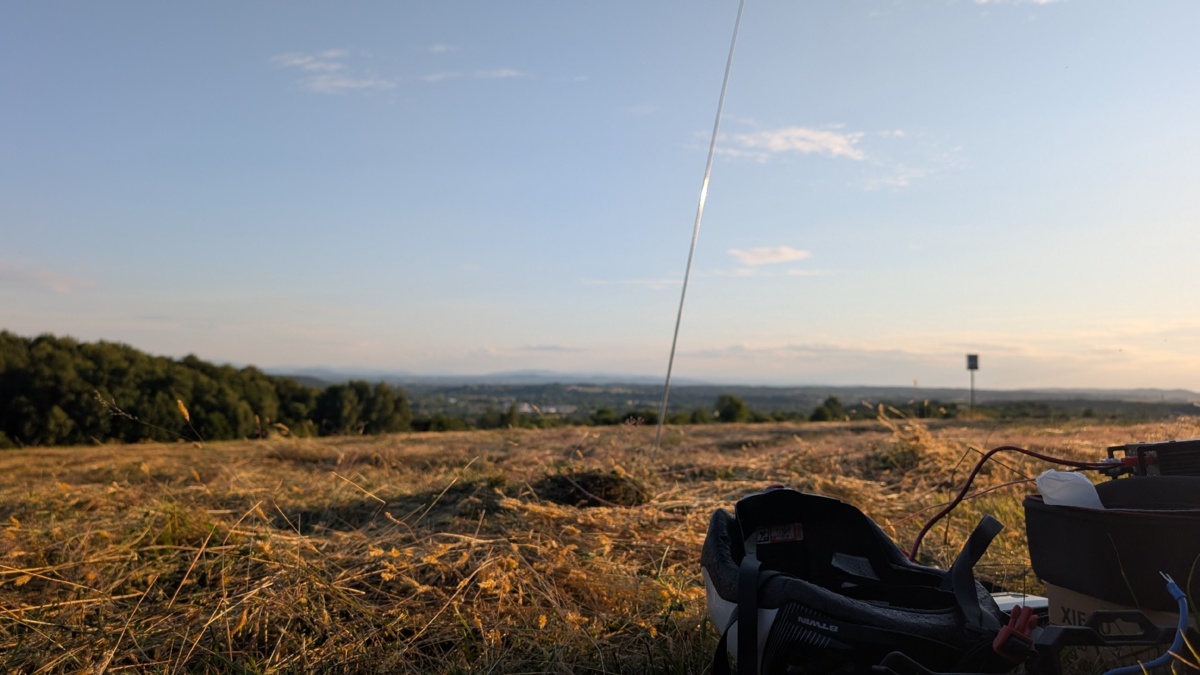
Wczoraj udało się zrobić krótki wypad radiowy z użyciem fal znacznie niższej częstotliwości niż typowe ręczne krótkofalówki.
Udało się dodzwonić z Małopolski do Portugalii, prawie 2500 kilometrów.

@kkdawid Czym się łączyłeś, na jakiej antenie i częstotliwości?

@chess_peppe antena to random wire: pionowy drut wbity w ziemie, do tego przeciwwaga: do "masy" podpięte kilka metrów kabla leżące luzem, potem transformator dopasowujący impedancę i kabel do radyjka. Częstotliwości to ~14MHz (pasmo 20 metrów) i 7 MHz (pasmo 40m). Chcieliśmy użyć również pasma 10M (28MHz) ale nie było propagacji: warunki w jonosferze nie pozwalały na odbicia fali o tej częstotliwośc
Zaloguj się aby komentować
Ktoś tu się zesrał. No ale cóż, na własne życzenie mają taki wizerunek.
https://www.facebook.com/share/p/1ET2aLjS38/
#wiadomoscipolska



No i? Ludzie wykonuja swoja prace a oszusci obrzucają ich gownem.

@Cybulion gdyby wykonywali swoją pracę to by nie było tych durnych salonów 777 na każdym rogu.

@Felonious_Gru Co jednak raczej nie jest winą kontrolerów, a ich szefów co zapewne nie narzekają że te salony działają
Zaloguj się aby komentować
Zaloguj się aby komentować
#usa #polska #ciekawostkihistoryczne #ciekawostki . źródło
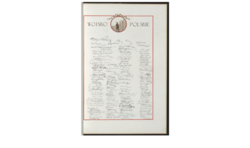
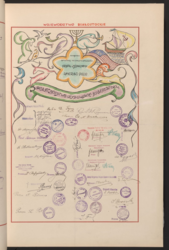
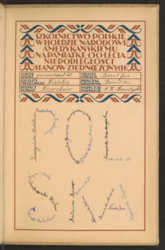
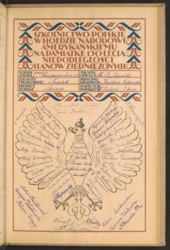
Polska Deklaracja o Podziwie i Przyjaźni dla Stanów Zjednoczonych (ang. Polish Declarations of Admiration and Friendship for the United States) – zbiór 111 tomów opracowanych w Polsce i dostarczonych do Białego Domu prezydentowi Calvinowi Coolidge z zamierzeniem uczczenia 150. rocznicy Deklaracji Niepodległości. Jednym z inicjatorów tej nietypowej akcji był Leopold Kotnowski, prezes Amerykańsko-Polskiej Izby Handlowo-Przemysłowej (American-Polish Chamber of Commerce and Industry in Poland)[1][2].
Zbiór opracowany w 1926 zawiera pozdrowienia i podpisy przedstawicieli wszystkich szczebli władz II Rzeczypospolitej (z prezydentem Ignacym Mościckim i premierem Kazimierzem Bartlem na czele, oraz posłami na Sejm i senatorami Rzeczypospolitej), duchownych (z prymasezniów szkół polskich. Wśród sygnatariuszy Deklaracji był także m.in . Józef Piłsudski. Podpisy zbierano w urzędach, kościołach, ale przede wszystkim w szkołach[2][1]. Wydaje się, że szkoły prześcigały się w oryginalności składanych życzeń. Chciały w osobliwy sposób wyróżnić się na tle pozostałych placówek, a do dyspozycji była zwykle zaledwie jedna, czasem dwie paginy[2]. Ich liczba uzależniona była od wielkości szkoły. Karty wdzięczności odsyłane przez szkoły, pięknie kaligrafowane, były często bogato zdobione w motywy kwiatowe, ilustracje, podpisy skoncentrowane wokoło pieczęci. Ponadto, prócz złożonych podpisów wklejano pocztówki, zdjęcia oddziałów klasowych, a nawet układano wierszyki[1].
Trzynaście pierwszych tomów tego zbioru zostało zeskanowanych przed 2010 r., reszta w 2017 r. Skany są dostępne na stronie internetowej Biblioteki Kongresu Stanów Zjednoczonych.

@Deykun polityka robienia laski ma zaskakująco długie korzenie
Zaloguj się aby komentować
jestem śpioncy
chyba od olanzapiny i pregabaliny
#gownowpis
Zaloguj się aby komentować
Wojna
Treść dla dorosłych lub kontrowersyjna
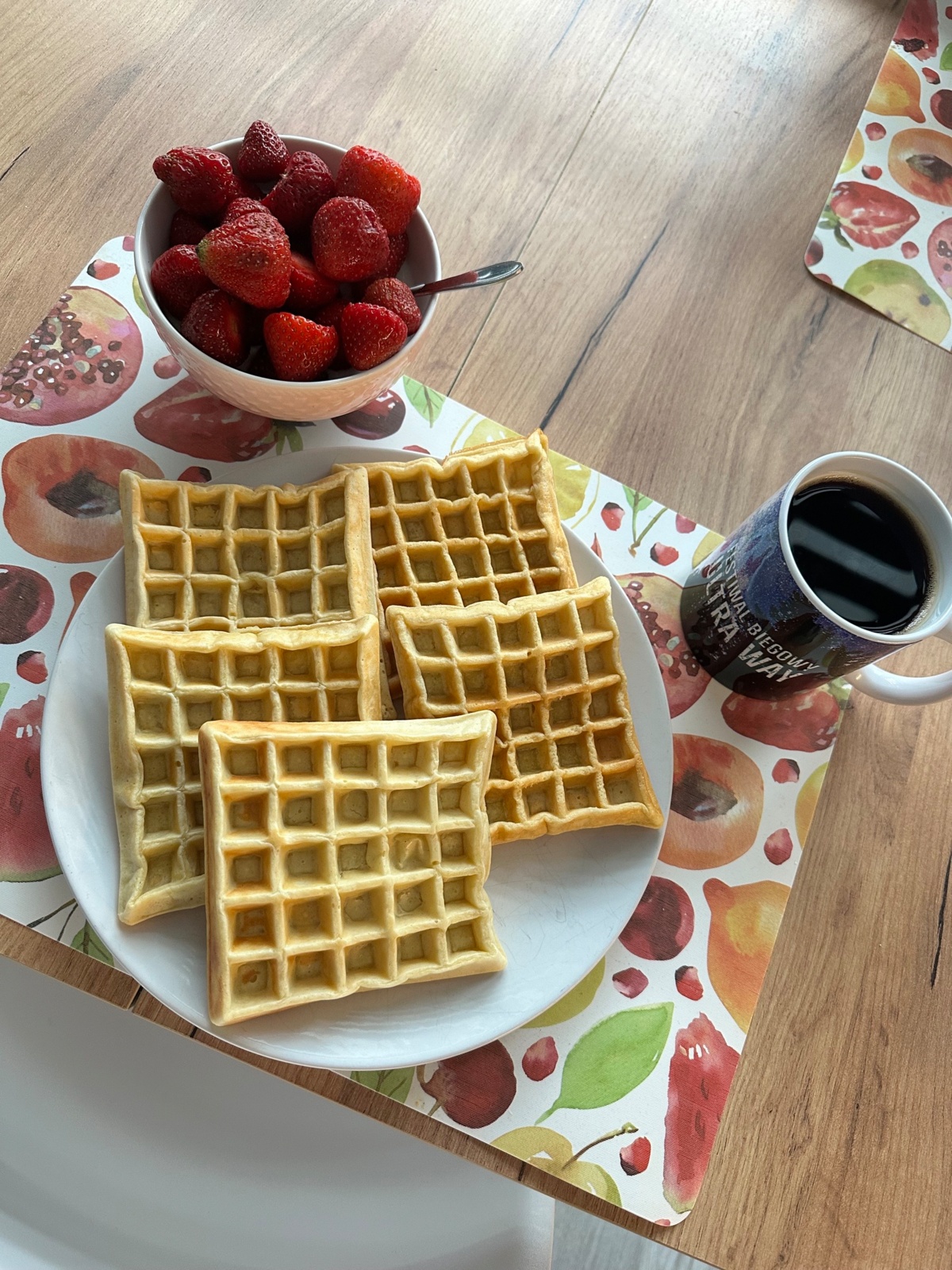
Gofry białkowe z jogurtem i truskawkami #sniadanie #jedzzhejto

@Trypsyna dej adres
Zaloguj się aby komentować
Wojna
Treść dla dorosłych lub kontrowersyjna
Pierwsze README #git napisane przez #linustorvalds w 2005. W następnym commicie który dotyka tego pliku obok zmienił .dircache/index -> .git/index.
GIT - the stupid content tracker
"git" can mean anything, depending on your mood.
- random three-letter combination that is pronounceable, and not
actually used by any common UNIX command. The fact that it is a
mispronounciation of "get" may or may not be relevant.
- stupid. contemptible and despicable. simple. Take your pick from the
dictionary of slang.
- "global information tracker": you're in a good mood, and it actually
works for you. Angels sing, and a light suddenly fills the room.
- "goddamn idiotic truckload of sh*t": when it breaks
This is a stupid (but extremely fast) directory content manager. It
doesn't do a whole lot, but what it does do is track directory
contents efficiently.
There are two object abstractions: the "object database", and the
"current directory cache".
The Object Database (SHA1_FILE_DIRECTORY)
The object database is literally just a content-addressable collection
of objects. All objects are named by their content, which is
approximated by the SHA1 hash of the object itself. Objects may refer
to other objects (by referencing their SHA1 hash), and so you can build
up a hierarchy of objects.
There are several kinds of objects in the content-addressable collection
database. They are all in deflated with zlib, and start off with a tag
of their type, and size information about the data. The SHA1 hash is
always the hash of the compressed object, not the original one.
In particular, the consistency of an object can always be tested
independently of the contents or the type of the object: all objects can
be validated by verifying that (a) their hashes match the content of the
file and (b) the object successfully inflates to a stream of bytes that
forms a sequence of + + <ascii decimal
size> + <byte\0> + .
BLOB: A "blob" object is nothing but a binary blob of data, and doesn't
refer to anything else. There is no signature or any other verification
of the data, so while the object is consistent (it is indexed by its
sha1 hash, so the data itself is certainly correct), it has absolutely
no other attributes. No name associations, no permissions. It is
purely a blob of data (ie normally "file contents").
TREE: The next hierarchical object type is the "tree" object. A tree
object is a list of permission/name/blob data, sorted by name. In other
words the tree object is uniquely determined by the set contents, and so
two separate but identical trees will always share the exact same
object.
Again, a "tree" object is just a pure data abstraction: it has no
history, no signatures, no verification of validity, except that the
contents are again protected by the hash itself. So you can trust the
contents of a tree, the same way you can trust the contents of a blob,
but you don't know where those contents came from.
Side note on trees: since a "tree" object is a sorted list of
"filename+content", you can create a diff between two trees without
actually having to unpack two trees. Just ignore all common parts, and
your diff will look right. In other words, you can effectively (and
efficiently) tell the difference between any two random trees by O(n)
where "n" is the size of the difference, rather than the size of the
tree.
Side note 2 on trees: since the name of a "blob" depends entirely and
exclusively on its contents (ie there are no names or permissions
involved), you can see trivial renames or permission changes by noticing
that the blob stayed the same. However, renames with data changes need
a smarter "diff" implementation.
CHANGESET: The "changeset" object is an object that introduces the
notion of history into the picture. In contrast to the other objects,
it doesn't just describe the physical state of a tree, it describes how
we got there, and why.
A "changeset" is defined by the tree-object that it results in, the
parent changesets (zero, one or more) that led up to that point, and a
comment on what happened. Again, a changeset is not trusted per se:
the contents are well-defined and "safe" due to the cryptographically
strong signatures at all levels, but there is no reason to believe that
the tree is "good" or that the merge information makes sense. The
parents do not have to actually have any relationship with the result,
for example.
Note on changesets: unlike real SCM's, changesets do not contain rename
information or file mode chane information. All of that is implicit in
the trees involved (the result tree, and the result trees of the
parents), and describing that makes no sense in this idiotic file
manager.
TRUST: The notion of "trust" is really outside the scope of "git", but
it's worth noting a few things. First off, since everything is hashed
with SHA1, you can trust that an object is intact and has not been
messed with by external sources. So the name of an object uniquely
identifies a known state - just not a state that you may want to trust.
Furthermore, since the SHA1 signature of a changeset refers to the
SHA1 signatures of the tree it is associated with and the signatures
of the parent, a single named changeset specifies uniquely a whole
set of history, with full contents. You can't later fake any step of
the way once you have the name of a changeset.
So to introduce some real trust in the system, the only thing you need
to do is to digitally sign just one special note, which includes the
name of a top-level changeset. Your digital signature shows others that
you trust that changeset, and the immutability of the history of
changesets tells others that they can trust the whole history.
In other words, you can easily validate a whole archive by just sending
out a single email that tells the people the name (SHA1 hash) of the top
changeset, and digitally sign that email using something like GPG/PGP.
In particular, you can also have a separate archive of "trust points" or
tags, which document your (and other peoples) trust. You may, of
course, archive these "certificates of trust" using "git" itself, but
it's not something "git" does for you.
Another way of saying the same thing: "git" itself only handles content
integrity, the trust has to come from outside.
Current Directory Cache (".dircache/index")
The "current directory cache" is a simple binary file, which contains an
efficient representation of a virtual directory content at some random
time. It does so by a simple array that associates a set of names,
dates, permissions and content (aka "blob") objects together. The cache
is always kept ordered by name, and names are unique at any point in
time, but the cache has no long-term meaning, and can be partially
updated at any time.
In particular, the "current directory cache" certainly does not need to
be consistent with the current directory contents, but it has two very
important attributes:
(a) it can re-generate the full state it caches (not just the directory
structure: through the "blob" object it can regenerate the data too)
As a special case, there is a clear and unambiguous one-way mapping
from a current directory cache to a "tree object", which can be
efficiently created from just the current directory cache without
actually looking at any other data. So a directory cache at any
one time uniquely specifies one and only one "tree" object (but
has additional data to make it easy to match up that tree object
with what has happened in the directory)
and
(b) it has efficient methods for finding inconsistencies between that
cached state ("tree object waiting to be instantiated") and the
current state.
Those are the two ONLY things that the directory cache does. It's a
cache, and the normal operation is to re-generate it completely from a
known tree object, or update/compare it with a live tree that is being
developed. If you blow the directory cache away entirely, you haven't
lost any information as long as you have the name of the tree that it
described.
(But directory caches can also have real information in them: in
particular, they can have the representation of an intermediate tree
that has not yet been instantiated. So they do have meaning and usage
outside of caching - in one sense you can think of the current directory
cache as being the "work in progress" towards a tree commit).
#programowanie
Zaloguj się aby komentować
Wojna
Treść dla dorosłych lub kontrowersyjna

@splash545 to byłem ja ale w końcu uświadomiłem sobie, że tak nie można i staram się przerywać takie myśli w zarodku

@Gilgamesh bardzo dobra decyzja. Bo na to, że takie myśli czasem przychodzą nie mamy wpływu, ale na to, żeby nie dać im paliwa i je uciąć, to już jest w naszej gestii. Kwestia treningu i wprawy.
Zaloguj się aby komentować
Powiedz, że spadanie liści też stanowi zły omen, podobnie jak to, że dojrzała figa zajmuje miejsce tej zielonej, a winogrona zamieniają się w rodzynki. Wszystkie te rzeczy stanowią bowiem przemianę z wcześniejszego stanu w inne stany; nie jest to zniszczenie, lecz pewna ustalona gospodarność i sposób zarządzania rzeczami. Czymś takim jest wyjazd z domu i niewielka zmiana; czymś takim jest też śmierć, większa przemiana - przejście ze stanu istniejącego a tej chwili nie do nicości, lecz do tego co nie istnieje w tym momencie. "A więc nie będę już dłużej istniał?". Nie będziesz istniał, lecz będziesz czymś innym, czego świat będzie w danym momencie potrzebował.
Epiktet, Diatryby
#stoicyzm

Zaloguj się aby komentować