Dyskusja użytkownika bojowonastawionaowca
Jak daleko w czasie jesteś w stanie zrozumieć angielski?
2000
Well, I finally got to the town everyone has been talking about lately. Wulfleet. And let me tell you, it was not easy to get here. It’s ridiculous how close this place is to London, and yet how hard it is to get here. I took a train to some place whose name I can’t pronounce, and then from there I had to hop on a bus. The whole day was shot just getting here.
Not going to lie though: so far, it’s totally worth it.
Yes, it’s the typical English coastal town: the seagulls, the cobblestone streets, the works. But there’s something about it that just makes me want to dress up in a cape and walk around like I’m in a Gothic novel. Although, let’s be honest, do I really need an excuse to do that?
Everyone seems really nice here, although I did have one really weird encounter on the way to the B&B. A guy was following me for a while. It kind of freaked me out. Anyway, if you go to Wulfleet, just watch out for this one weird guy who hangs out near the bus stop. I know, real specific. But anyway, that was just a bit odd.
Speaking of which, the B&B is also… interesting. LOL. It has separate hot and cold taps and everything. I’m about to see how the “bed” portion works. I’ll update you on the “breakfast” tomorrow morning. If I can find an internet cafe around here, that is.
1900
My plans for an untroubled sleep were upset, however, when I woke with a start before dawn. The window had, it seemed, come open in the night, though I was perfectly certain I had fastened it. I sprang up from the bed to see what was the cause, but I could see nothing in the darkness — nothing, that is, that I could satisfactorily account for. I closed the window again but was entirely unable to fall asleep due to the shock. I am not, I hope, an easily frightened man, but I confess the incident left me not a little unsettled.
When dawn finally came, I went downstairs to find a well-appointed dining room in which there was laid out a modest but perfectly adequate meal. After I ate, and thanked the landlady — a respectable woman of the kind one expects to find in charge of such an establishment — I decided to take a stroll around the town. The sea air did something to revive me after the events of the previous day, not to mention the night, although a question still weighed on me. Do windows simply burst open in the night? Or was there something else afoot? I resolved to make enquiries, though of whom I was not yet certain.
1800
After spending the day wandering around the environs of the town, and, finding myself hungry, I sought out an inn, where I might buy some supper. It was not difficult to find one, and, sitting alone, I called for supper from what the publican had to offer. I confess I gave no great thought to the quality of the fare. Hunger, that great leveller, makes philosophers of us all, and renders even the meanest dish agreeable.
The place was adequately charming. The tables were covered with guttering candles, and the local rustics seemed to be amusing themselves with great jollity. Reader, I am not one of those travellers who holds himself above the common people of the places he visits. I saw fit rather to join in with their sport and we whiled away the hours together in good cheer. I found them to be as honest and amiable a company as one could wish for.
The only thing that disturbed my good humour was when I thought, for a brief moment, that I saw the man who accosted me yesterday among the crowd. But it must have been a mere fancy, for whatever I thought I saw vanished as quickly as it had appeared. I chided myself for the weakness of my nerves, and took another draught to steady them.
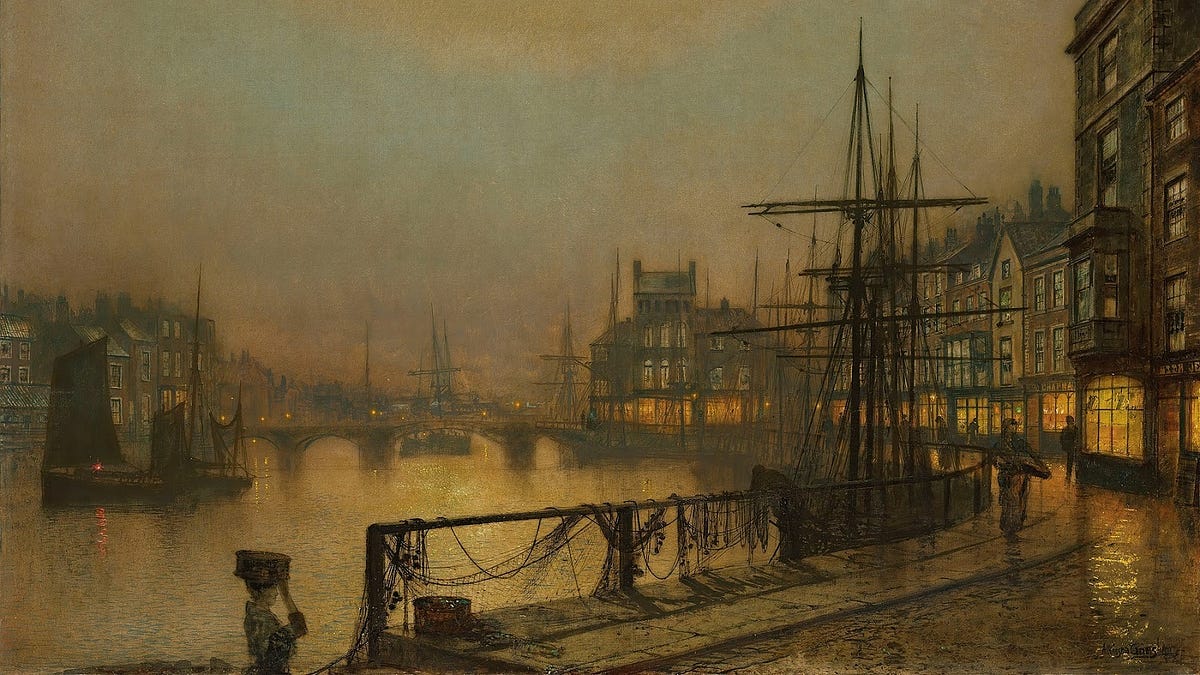
When, at long last, the entertainment was spent, I undertook to return to my lodgings; however, finding myself quite unable to find my way, a fact which owed something to having imbibed rather immoderately in the hours prior — and here let me caution the reader against the particular hospitality of country innkeepers, which is liberal beyond what prudence would advise — I soon found myself at the harbour’s edge.
1700
When I was firſt come to Wulfleet, I did not see the harbour, for I was weary and would ſooner go to the inn, that I might ſleep. It is a truth well known to travellers, that wearineſs of body breeds a kind of blindneſs to all things, however remarkable, and ſo it was with me. But now that I beheld the ſight of it, I marvelled. In the inky blackneſs I could see not a ſtar, nor even a ſliver of the moon. It was indeed a wonder that I did not ſtumble on my way, and periſh in a gutter, for many a man has come to his end by leſs.
Finally, with my mind much filled with reflection, I found my way through dark ſtreets to a familiar alley. This was a welcome sight, as an ill foreboding was lately come into my mind. I entertained for a moment such unmanly thoughts as are far from my cuſtom, and which I ſhould be aſhamed to ſet down here, were it not that an honeſt account requires it. I felt eſpecially that I was purſued by ſome thing unknown to me. I glanced backwards, to ſee if I might eſpy that man. But there was no one, or at least no one that I could diſcern.
At laſt, I found the doorway of the inn, as much by chance as by deſign, and retired to ſleep with a mind addled half by drink and the other half by a fear for which I could not well account. I commended myſelf to Providence, and reſolved to think no more on it.
1600
That night I was vntroubled by such euents as I had vndergone the night before, for I had barred the door ere I ſlept, and so fortified, that so no force might open it. This town of Wulfleet was paſſing ſtrange, as ſtrange I dare ſay as any place whereof Plinie wrote, or any iland discovered in the voyages of Sir Walter Raleigh. But I was bound to my taſk, and would not flinch from it. I would record the occurrents in Wulfleet, howeuer ſtrange they might ſeem, yea, though they were ſuch things as would make a leſſer man forſake his purpoſe.
But I ſoon forgot my earlier dread, for the morning brought with it ſo fair a ſight as to diſpel all feare. The people of the town had erected ouernight a market of ſuch variety and abundance as I haue not ſeen the like. Animals walked among men, and men among animals, a true maruel!
As I looked on this aſſembled throng, greatly pleaſed and not a little amazed, a man approached me. He ſtartled me, but I quickly saw he was nothing but a farmer come to hawke his wares. “Would you haue a fowl, sir?” ſaid he, “My hens are fat and luſty, and you may haue them cheap.”
I said in reply, “No, I thanke thee,” He was a churliſh fellow, rude of ſpeech and meane of aſpect, and I felt no ſhame at thouing ſuch a man as that.
1500
I went forthe among the people, and as I paſſed throughe the market and the ſtretes of the towne, euer lokyng aboute me with grete care, leſt I ſholde agayn encountre ſome peryl, thee appeared, from oute of the prees that ſame man whom I ſo dredde. And he was passyng foule was of vyſage, as it ſemed to me, more foule than ony man I had ſene in al my lyf.
He turned hym towarde me and ſayd, “Straunger, wherefore art thou come hydder?”
And I anſwerd hym nott, for I knewe nott what I ſholde ſaye, ne what answere myght ſerue me beſt in ſuche a caas.
Than hee asked me, “Was it for that thou wouldeſt ſee the Maiſter?”
And verely this name dyd me ſore affright, for who was this Maiſter wherof he ſpake? And what maner of man was he, that his very name ſholde be ſpoken wyth ſuche reuerence and drede. I wolde haue fledde but he purſued me and by myn avys he was the ſwifter, for he caught me full ſoone.
I sayd to him, “What meaneſt thou? Who is the Maiſter?”
And he sayd, “I ſhall brynge the vnto hym, and thou ſhalt ſee for thy ſelf what maner of lorde he is.”
But I wolde not, and cryed out ayenſt hym with grete noyſe, leſt he ſholde take me thyder by violence and ayenſt my wille.
1400
Bot þe man wolde me nat abandone þer, ne suffre me to passen forþ. I miȝt nat flee, for hys companiouns, of whom þer were a gret nombre, beſet me aboute, and heelden me faſt þat I ne scholde nat ascapen. And þei weren stronge menn and wel douȝti, of grymme contenaunce and fiers, and armed wiþ swerdes and wiþ knyues, so þat it were gret foly for eny man to wiþstonden hem.
So þei bounden me hond and foot and ledden me to þe one þei callede Maiſter, of whom I hadde herd so muchel and knewe so litel.
Þe sayde Maiſter, what that hee apperid bifore me, was verely a Deuill, or so me þouȝte, for neuer in al my lyf hadde I beholden so foule a creature. Hee bore a blak clok þat heng to þe grounde, and ſpake neuer a worde. Bot his countenaunce was hidous and so dredful þat my blood wexed colde to loken on hym. For he hadde nat þe visage of a man bot of a beest, wiþ þe teeþ and ſnoute of a wulf, scharpe and crueel. And his eres weren longe eres, as of a wulf, and bihynde him þer heng a gret tayl, as wulf haþ. And hys eyen schon in þe derknesse lyke brennyng coles.
“What wolden ȝe wiþ mee, ȝe heþene?” aſked I, þouȝ myn voys quaked and I hadde litel hope of eny merci.
Bot þei maden no answer, neyþer good ne yuel. Þei weren stille as stoon, and stoden about me as men þat wayte on þeir lordes commandement.
1300
Þanne after muchel tyme spak þe Maiſter, and his wordes weren colde as wintres is. His vois was as þe crying of rauenes, scharpe and schille, and al þat herde hym weren adrade and durst nat speken.
“I deme þe to þe deeþ, straunger. Here ſchaltou dyen, fer fram þi kynne and fer fram þine owen londe, and non ſchal knowen þi name, ne non schal þe biwepe.”
And I sayde to hym, wiþ what boldenesse I miȝte gaderen, “Whi fareſt þou wiþ me þus? What treſpaas haue I wrouȝt ayeins þe, þat þou demeſt me so harde a dome?”
“Swie!” quoþ he, and smot me wiþ his honde, so þat I fel to þe erþe. And þe blod ran doun from mi mouþe.
And I swied, for þe grete drede þat was icumen vpon mee was more þan I miȝte beren. Mi herte bicam as stoon, and mi lymes weren heuy as leed, and I ne miȝte namore stonden ne spoken.
Þe euele man louȝ, whan that he sawe my peine, and it was a crueel louȝter, wiþouten merci or pitee as of a man þat haþ no rewþe in his herte.
Allas! I scholde neuer hauen icumen to þis toune of Wuluesfleete! Cursed be þe dai and cursed be þe houre þat I first sette foot þerinne!
1200
Hit is muchel to seggen all þat pinunge hie on me uuroȝten, al þar sor and al þat sorȝe. Ne scal ic nefre hit forȝeten, naht uuhiles ic libbe!
Ac þer com me gret sped, and þat was a uuif, strong and stiþ! Heo com in among þe yuele men and me nerede fram heore honden.
Heo sloȝ þe heþene men þat me pyneden, sloȝ hem and fælde hem to þe grunde. Þer was blod and bale inouȝ And hie feollen leien stille, for hie ne miȝten namore stonden. Ac þe Maister, þe uuraþþe Maister, he flaȝ awei in þe deorcnesse and was iseon namore.
Ic seide hire, “Ic þanke þe, leoue uuif, for þu hauest me ineredd from dæðe and from alle mine ifoan!”
1100
Þæt ƿif me andsƿarode and cƿæð, “Ic eom Ælfgifu gehaten. Þu scalt me to ƿife nimen, þeah þe þu hit ne ƿite gyt, for hit is sƿa gedon þæt nan man ne nan ƿif ne mote heonon faren buten þurh þone dæð þæs Hlafordes.”
“Ac þær is gyt mare to donne her, forþi ƿe nabbaþ þone Hlaford ofslagenne. He is strong and sƿiðe yfel, and manige gode men he hæfð fordone on þisse stoƿe.”
“Is þæt soð?” cƿæþ ic, forþon þe ic naht ne ƿiste. “Ic ƿende þæt ic mihte heonon faren sƿa ic com.”
“Gea la,” cƿæð heo. “Hit is eall soð, and ƿyrse þonne þu ƿenst.”
1000
And þæt heo sægde wæs eall soþ. Ic ƿifode on hire, and heo ƿæs ful scyne ƿif, ƿis ond ƿælfæst. Ne gemette ic næfre ær sƿylce ƿifman. Heo ƿæs on gefeohte sƿa beald swa ænig mann, and þeah hƿæþere hire andƿlite wæs ƿynsum and fæger.
Ac ƿe naƿiht freo ne sindon, for þy þe ƿe næfre ne mihton fram Ƿulfesfleote geƿitan, nefne ƿe þone Hlaford finden and hine ofslean. Se Hlaford hæfþ þisne stede mid searocræftum gebunden, þæt nan man ne mæg hine forlætan. Ƿe sindon her sƿa fuglas on nette, swa fixas on ƿere.
And ƿe hine secaþ git, begen ætsomne, ƿer ond ƿif, þurh þa deorcan stræta þisses grimman stedes. Hƿæþere God us gefultumige!
Źródełko: https://www.deadlanguagesociety.com/p/how-far-back-in-time-understand-english gdzie znajdziecie wytłumaczenie co i jak zmieniało się w poszczególnych okresach czasu
#angielski #historia #ciekawostki
#owcacontent