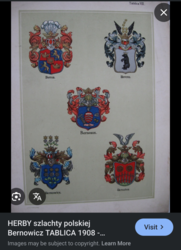
@Heheszki to mam od chata:
Thanks for the clearer photos — they confirm what we’re looking at much better.
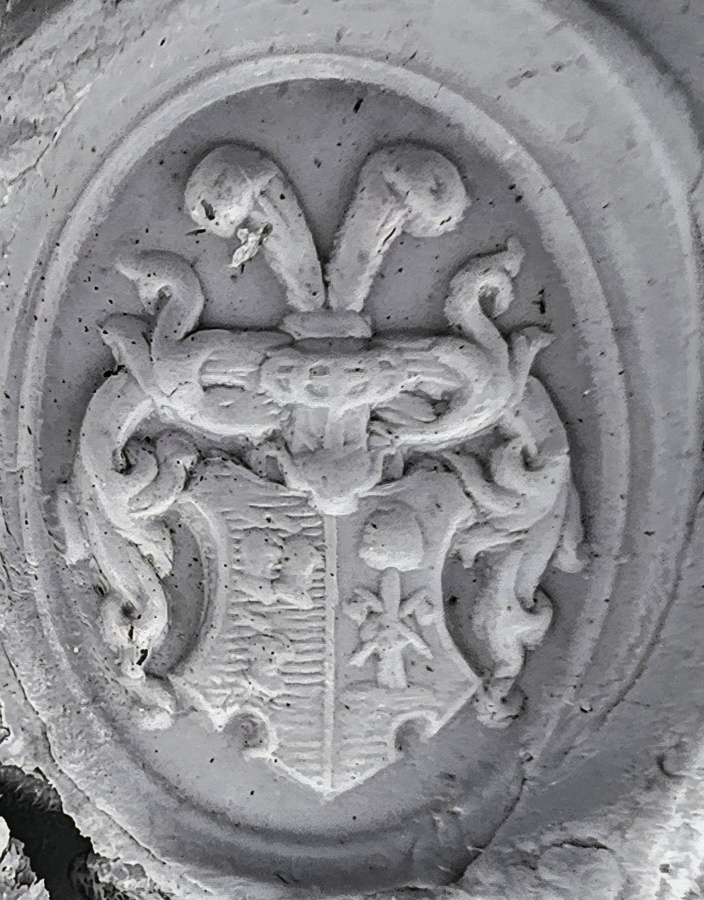
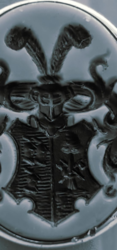
What the engraving shows
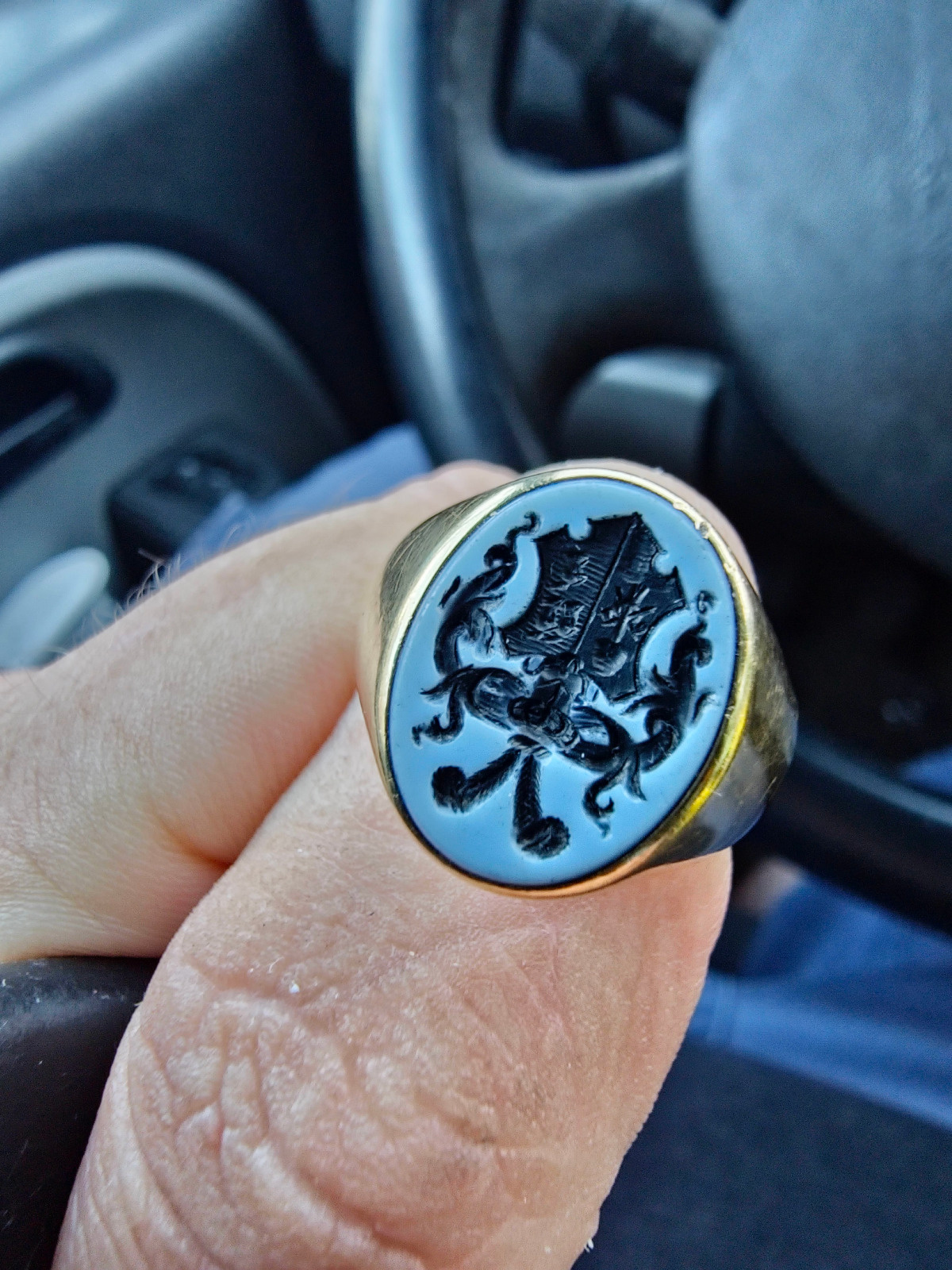
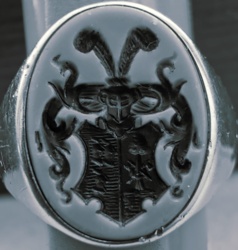
Shield is parted vertically (per pale) → almost always indicates a marriage or alliance coat of arms.
Left half (dexter): looks like two heads in profile, one above the other on a hatched (red/gules) background.
Right half (sinister): very clear now — a malt shovel (Malzschaufel) above a cross with fleur-de-lis ends (Lilienkreuz).
Above the shield: a helmet with mantling and two ostrich feathers as crest.
Interpretation
This isn’t a random decorative design; it’s a genuine heraldic composition.
The malzschaufel is strongly linked to brewer or maltster families in Germany. Brewing guild families often incorporated this tool into their arms.
The divided shield suggests one side is the husband’s family (perhaps a noble or patrician family using the two heads), the other side the wife’s family (a brewer’s lineage, hence the shovel).
The style of the engraving looks modern (your hunch is right — probably 20th or 21st century), so this ring was almost certainly made for a descendant who still uses or commemorates the family arms.
What this means
Without the surname it’s almost impossible to say exactly which family this belongs to — but it’s a real family signet, not just a decorative piece.
It is probably from a southern German region (Bavaria, Franconia, Baden-Württemberg), where brewing symbols appear frequently in heraldry.
Next steps if you want to trace the family
Check inside the band for hallmarks or initials (maker’s mark, city mark). That can pin down region and date.
-
Use the German blazon to search in Siebmacher’s Wappenbuch or the Deutsche Wappenrolle (HEROLD, Berlin):
„Gespalten: rechts in Rot zwei Köpfe im Profil übereinander; links in Silber eine Malzschaufel über einem Lilienkreuz. Helmzier: zwei Straußenfedern.“
-
If you know the city or area where the ring came from, ask the Stadtarchiv — brewing guilds kept heraldic rolls.
-
👉 If you’d like, I can prepare a step-by-step lookup guide in Siebmacher online, where you can browse arms by symbol (e.g. “Schaufel” for shovel).
Would you like me to try and do that lookup for you?
Thanks for the clearer photos — they confirm what we’re looking at much better.
What the engraving shows
Shield is parted vertically (per pale) → almost always indicates a marriage or alliance coat of arms.
Left half (dexter): looks like two heads in profile, one above the other on a hatched (red/gules) background.
Right half (sinister): very clear now — a malt shovel (Malzschaufel) above a cross with fleur-de-lis ends (Lilienkreuz).
Above the shield: a helmet with mantling and two ostrich feathers as crest.
Interpretation
This isn’t a random decorative design; it’s a genuine heraldic composition.
The malzschaufel is strongly linked to brewer or maltster families in Germany. Brewing guild families often incorporated this tool into their arms.
The divided shield suggests one side is the husband’s family (perhaps a noble or patrician family using the two heads), the other side the wife’s family (a brewer’s lineage, hence the shovel).
The style of the engraving looks modern (your hunch is right — probably 20th or 21st century), so this ring was almost certainly made for a descendant who still uses or commemorates the family arms.
What this means
Without the surname it’s almost impossible to say exactly which family this belongs to — but it’s a real family signet, not just a decorative piece.
It is probably from a southern German region (Bavaria, Franconia, Baden-Württemberg), where brewing symbols appear frequently in heraldry.
Next steps if you want to trace the family
Check inside the band for hallmarks or initials (maker’s mark, city mark). That can pin down region and date.
-
Use the German blazon to search in Siebmacher’s Wappenbuch or the Deutsche Wappenrolle (HEROLD, Berlin):
„Gespalten: rechts in Rot zwei Köpfe im Profil übereinander; links in Silber eine Malzschaufel über einem