Number of cars per inhabitant increased in 2021
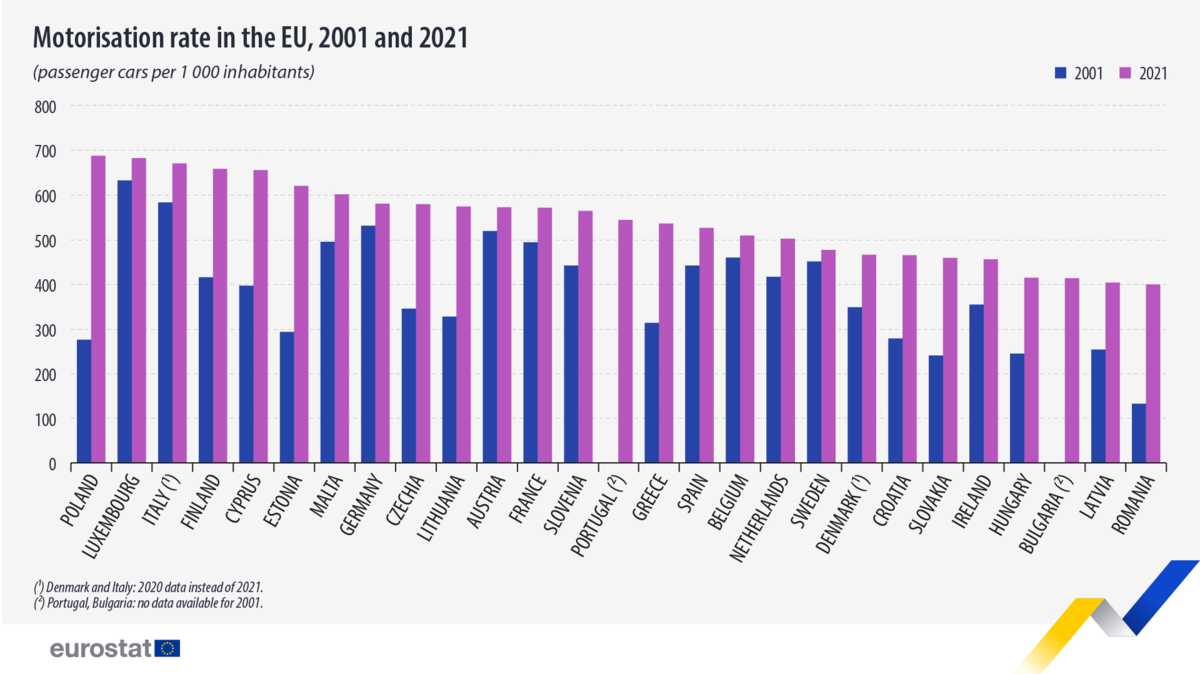
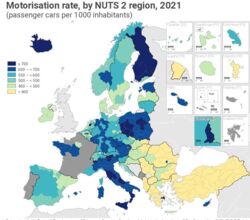
In 2021, the average number of passenger cars per inhabitant in the EU increased from 0.53 to 0.57. Data show that western EU countries recorded higher motorisation rates (passenger cars per 1 000 inhabitants) than central and eastern EU members. However, at a regional level, there were significant disparities in car ownership within the EU. Regional rates are often linked to the economic situation but can also be affected by specific circumstances. For example, the high motorisation rate in Valle d’Aosta (Italy) is influenced by favourable taxation rules. This information comes from data on transport statistics published by Eurostat today. The article presents a handful of findings from the more detailed Statistics Explained article on the stock of vehicles at the regional level. Source dataset: trans_r_vehst Between 2001 and 2021, Romania registered the highest average annual growth rate of passenger cars per 1 000 inhabitants (motorisation rate) among the EU members (+5.4%), followed by Poland (+4.5%). At the opposite end of the scale, Malta and the Netherlands (both +0.9%), Spain (+0.8%), France and Italy (both +0.7%), Belgium and Austria (both +0.5%), Germany and Luxembourg (both +0.4%), and Sweden (+0.3%) were the countries recording average annual growth rates below 1 %. In general, the Baltic, eastern and central European EU countries registered stronger growths than western EU countries between 2001 and 2021. Source dataset: tran_r_vehst Motorisation rate for utility vehicles When looking at utility vehicles (lorries, road tractors and special vehicles excluding trailers and semi-trailers) there are no systematic differences between western and eastern EU regions. The share of utility vehicles in the total number of road vehicles in a region depends on several factors. Among these are the regional transport systems and infrastructure for different modes of freight transport, such as motorways, railway lines, ports and airports. The economic characteristics of a region also play a role i.e., whether the regional economy is dominated by manufacturing industries or services, and whether the region is located on key European freight corridors. The two NUTS 2 regions registering the highest numbers of utility vehicles in 2021 were Andalusia (more than 1 million) and Catalonia (845 000). Both these Spanish regions play a key role in freight transport in the west Mediterranean region, with direct ferry connections not only with the Spanish islands and Ceuta and Melilla but especially between Andalusia and Morocco and Algeria, and between Catalonia and Italy.
Europa