Panos Pictures - Stories - The Taliban's Drug Hell
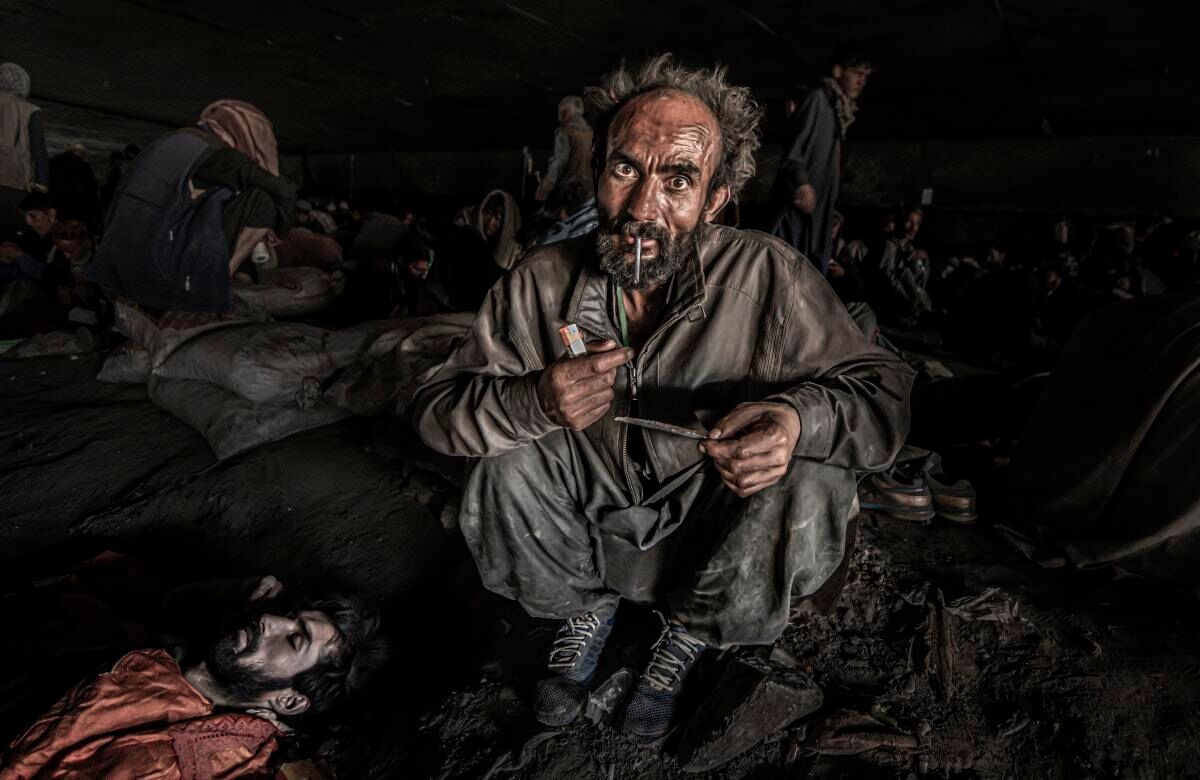
The dark sea of huddled forms is almost impossible to take in at first. The grimy, bent figures resemble residents of some vast, squalid dungeon. In the filthy riverbed nearby, scattered lifeless figures look like the aftermath of a battle, or an air crash. There are close to 1,000 drug addicts sheltering under this bridge in a western neighbourhood of the Afghan capital. The ragged mass soon resolves into many vignettes, each briefly illuminated by the flare of cigarette lighters.~~Several men with glazed, staring eyes appear little more than skeletons and can surely not have long to live. Some stand hunched and oblivious like zombies. Groups bunch together to smoke drugs from heated pieces of tin foil. There is a buzz of industry around another man making bulbous glass drug pipes. Another squats and fastidiously trims his beard with scissors, despite the filth around him. An optimistic tradesman picks his way through the mass, selling cups of tea. Traffic and normal life continue overhead.~~'There's a lot of good people here,' says one man, looking at the crowds of fellow addicts. 'Engineers, doctors, educated people. But they have problems with drugs. The problem is getting worse, day by day.' Pul-e-Sukhta bridge was known as a hangout for Kabul's wretched drug addicts long before the Taliban regained power last August. While the battle to stop Afghanistan's drug trade is often framed as a fight to keep heroin off Western streets, that drug and others do terrible damage closer to home.~~A 2015 survey estimated the country had somewhere between 1.9m and 2.3m regular drug users in a country of 39m. It is thought to have one of the highest proportions of opium or opiate use in the world. Now the scale of the economic collapse brought by the Taliban victory and a burgeoning new trade in methamphetamine is making the situation worse. Almost all the addicts under the bridge said they were addicted to either heroin or meth. Each had a different story to tell. Many said they had become addicted while migrant workers in neighbouring Iran.~~'When I first took it, I felt strong,' explains one man. 'Many take drugs to have energy or avoid sleep when working.' Another said he had been in the collapsed Afghan army and become addicted to heroin while fighting the Taliban on dangerous, grinding tours of the country's southern provinces. Syed Ramin, aged 32, says he got hooked on heroin and then later meth after he became depressed after his engagement fell through. 'I was a graduate from school and I prepared for college and loved a girl and I was unsuccessful. The family did not approve. After that, there was no chance for me, so I just used heroin to calm myself.'~~When the Taliban took power in August 2021, they declared they would quickly solve the capital's drug problem. They rounded up thousands of addicts off the streets, forcing them into the capital's Ibn Sina rehabilitation hospital. The hospital boasts 1,000 beds, but staff recall that after the Taliban raids, there were three patients in each one. Faced with overcrowding, violence and conditions that offered little prospect of weaning anyone off drugs, the hospital doctors persuaded their new Taliban masters to stop rounding addicts up.~~The hospital, on the road out of Kabul to Jalalabad, has now gone to the other extreme. With around 300 patients, the former military camp feels deserted. Abdul Nasir Munqad is the Taliban leader appointed director of the hospital. He spent three years in the Bagram high-security prison north of Kabul after being captured fighting for the Taliban, but now oversees doctors and nurses, accompanied by his entourage of bodyguards. He denies the drug situation is getting worse in Afghanistan and blames the 'drug mafia' of the former government for the number of addicts.
Panos