Dyskusja użytkownika Deykun

In mathematics, the Jacobian conjecture is a disproven conjecture concerning polynomials in several variables. It states that if a polynomial function from an 𝒩-dimensional space to itself has a Jacobian determinant which is a non-zero constant, then the function has a polynomial inverse. The conjecture was first stated for two variables by Ludwig Kraus in 1884[1] and then restated for integer-coefficient polynomials in 𝒩 variables in 1939 by Ott-Heinrich Keller.[2] It was subsequently widely publicized by Shreeram Abhyankar,[3] as an example of a difficult question in algebraic geometry that can be understood using little beyond a knowledge of calculus.
The Jacobian conjecture is number 16 in Stephen Smale's 1998 list of Mathematical Problems for the Next Century.[4] It was notorious for the large number of published and unpublished false proofs that turned out to contain subtle errors.[5][6]
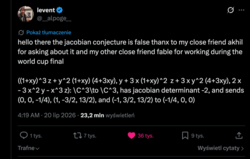
On July 19, 2026, Anthropic employee and mathematician Levent Alpöge presented an explicit counterexample in three-dimensional space, discovered using Claude Fable 5, Anthropic's large language model, which disproves the conjecture for 𝒩 > 2.[7] For the special case 𝒩 = 2 the conjecture remains an unsolved problem as of July 2026, while for 𝒩 = 1 it can be proven trivially.[8]
https://x.com/alpoge/status/2079028340955197566
#matematyka #ai #anthropic